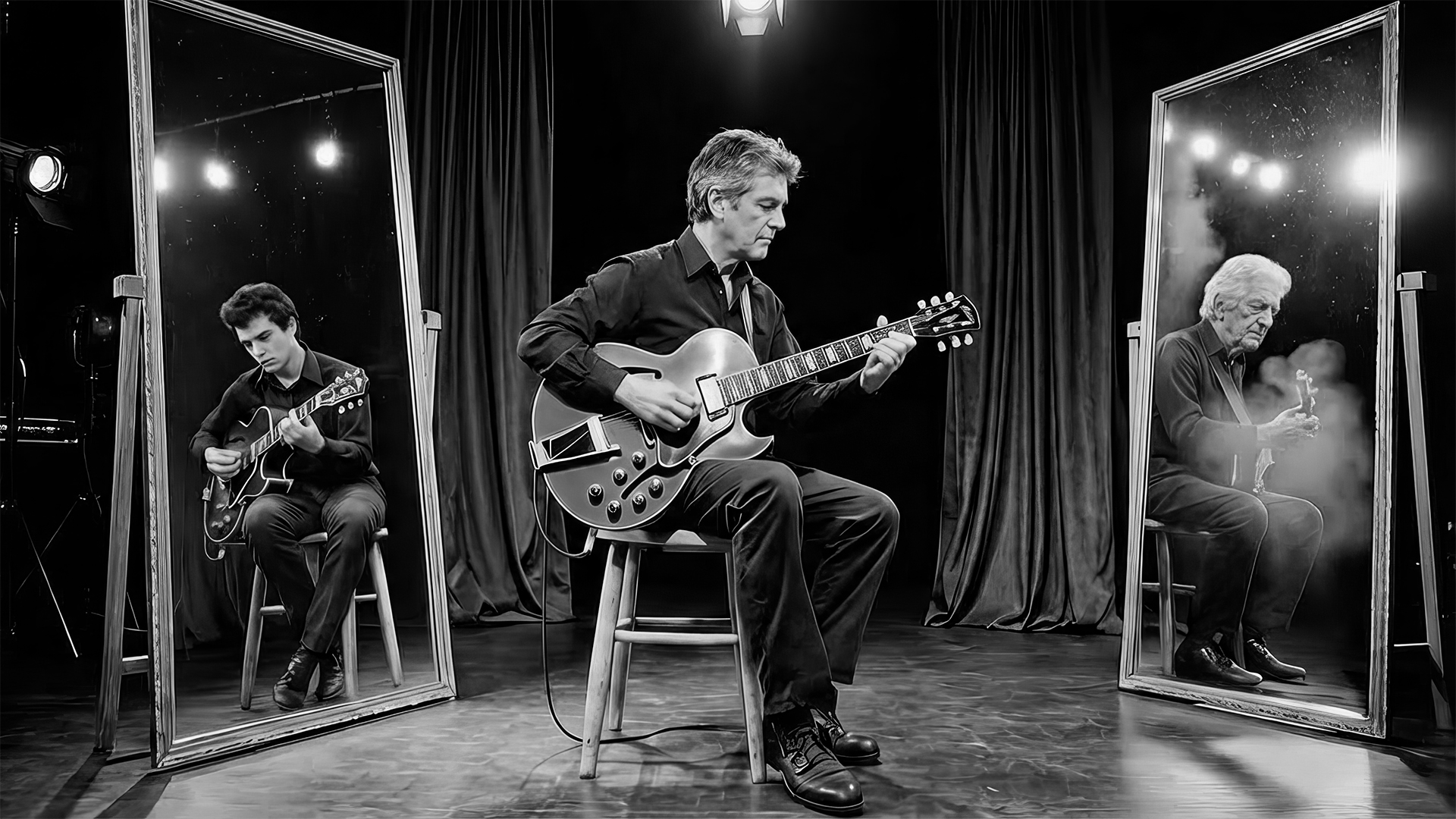
Be yourself, and a little more.
It's a strange thing, culture. It demands a balance of fitting in and standing out to make an impact — yet upstarts and established brands alike succumb to its mercurial influence.
We've all watched it happen. Even the bold ones that promised to break every rule end up looking remarkably alike. Same on-point typeface. Same knowing tone. Same carefully art-directed rebellion. Trends harden into a visual language, spread through a community, and quietly become the new industry standard.
Standing out requires disruption, and disruption sounds dramatic. But drama is in the eye of the beholder. A move that reads as incremental to one audience can be monumental to another.
Consider the financial industry, a traditionally risk-averse sector where stability and security sit at odds with the unproven, untested, and new. A dramatic change that might be advantageous in food & beverage could be far too playful for a serious audience concerned with matters requiring expertise and sound judgment.
So how does a brand make a stand that is bold, but not too bold?
This is the question that led us to expand our Brand Character Model. When we introduced the model, it considered three dimensions: how a brand thinks, how it behaves, and how it interacts with others. Those questions still hold. But as the need for nuance grew, a fourth surfaced — one that deepens our understanding of an organization's character.
How a brand appears.
The fourth lens
The expanded model now considers four dimensions of Brand Character, each organized around a single question. How a brand thinks measures its comfort with ambiguity. How it behaves reflects its comfort with risk. How it interacts, its comfort with vulnerability.
How a brand appears explores its comfort with conformity.
Note that appearance here is not about style or trends. It asks something more revealing: how comfortable is this organization aligning with the norms of its category — visually, verbally, tonally — and how comfortable is it diverging from them?
Nobody differentiates by refusing the party
Think of a category as a dinner party. Every brand in the room accepted to share in the occasion, the codes, the unspoken ties that make the gathering legible — this is what allows someone to walk in and instantly understand the room they're in.
The invitation said creative black-tie. Everyone in the room is held to the same standard — belong and be distinct, at once. That's the price of admission, a common canvas with freedom to create your own image.
Conformity, in this sense, is belonging.
The differentiation question is who to be once you're there. Every gathering has its roles: the host who puts everyone at ease, the storyteller holding the corner of the room, the quiet observer everyone ends up trusting, the one who finally gets people dancing. Each role belongs fully to the party. No two of them are confused for one another.
Brands with genuine character ask a better question: what role does this room need, and which one can we authentically play?
What the lens measures
In practice, the Appear lens examines five spectrums of expressiveness:
Familiar or Surprising.
Tranquil or Lively.
Classic or Current.
Smooth or Rugged.
Dark or Bright.
Individually, each pairing seems almost too simple. But, together, they surface something rarely articulated: an organization's expressive temperature in relation to the norms of its space — the one it can carry every day, across every touchpoint, without flinching.
Every organization strives for some combination of these characteristics. Expression fails when a brand borrows a temperature it can't hold. It succeeds when the level and kind are ones the organization can authentically sustain — and finding that measure is the work of the model.
The lens that moves
One more thing, maybe the most consequential.
Of the four lenses, three are indelibly stable. How an organization thinks, behaves, and interacts tends to hold steady through personnel changes and market cycles — these reflect its structural culture.
But Appear is different. It shifts with the people who carry the brand, the pressures they face, and the audiences they're reaching. A brand that was comfortable standing out five years ago may be quietly retreating from that posture today — not because its character changed, but because the organization carrying it did.
Which means how a brand appears isn't a question you answer once and file away. It's the one you keep asking. It's the quiet engine behind brand refreshes and evolutions — situations change, and organizations adapt in the ways most true to themselves.
Where character meets design
The Brand Character Model, complete with its fourth lens, gives an organization a declared position: this is how we think, behave, interact, and appear. A compass, not a costume.
But a declaration is only the beginning. Character, once defined, must translate into expression — into type and color and tone and every sensory decision a brand makes. That translation is a discipline of its own, and it's where the real craft begins.
The room is full of guests.
Be yourself, and a little more. Find the role the room needs — and fill it as only your brand can.
That's how people will remember your name.

About the Author
Thom Wolfe is a brand design expert and founding partner at The Indelible with extensive brand-building experience for companies such as GE, IBM, Marvin, Kohler, and Cargill. From strategy and brand design to digital and physical experiences, his twenty years of leadership have been influential in implementing brands at the highest levels. In addition, his Grammy Award-winning work has been recognized by The One Show, D&AD, and featured in several books.
The Indelible is a brand consultancy working with leaders who want to make a lasting mark. We've helped organizations across B2B, industrial, consumer, and financial sectors discover and express what makes them genuinely, irreducibly themselves.
Follow/connect with me on LinkedIn